Derisk your data center
in minutes, not weeks
Screen out bad sites early. Spark checks thousands of parcels for zoning, permitting and local opposition risk in minutes, so your team only spends time and money on sites that can reach operation.

Download a diligence report on any county, township, or parcel.
Zoning, community sentiment, moratoria, and political stakeholders, with every finding linked to its source.
Trusted by leading data center & energy infrastructure developers
Metrics from data center, power, and energy developers on Spark
Trusted by leading data center and energy infrastructure developers


The largest database, built for developers
Spark collects the local records that decide whether a project gets built, from project filings to commissioner meeting videos, and keeps them current. Over a terabyte of data, updated daily, so you're the first to know what's changed.
Every answer cites its source
Generic AI tools guess. Spark shows its work, so you can verify any finding in one click.
Every finding links to the source
Zoning rules, moratoria, votes, and opposition signals each link to the exact document they came from.
Built bottom-up, not projected
Catch the local nuances at every site. We answer from what happens on the ground, not with inaccurate projections.
Ready for investors and executives
Exportable briefs for decision-makers, investors, and buyers at the touch of a button.
Example finding
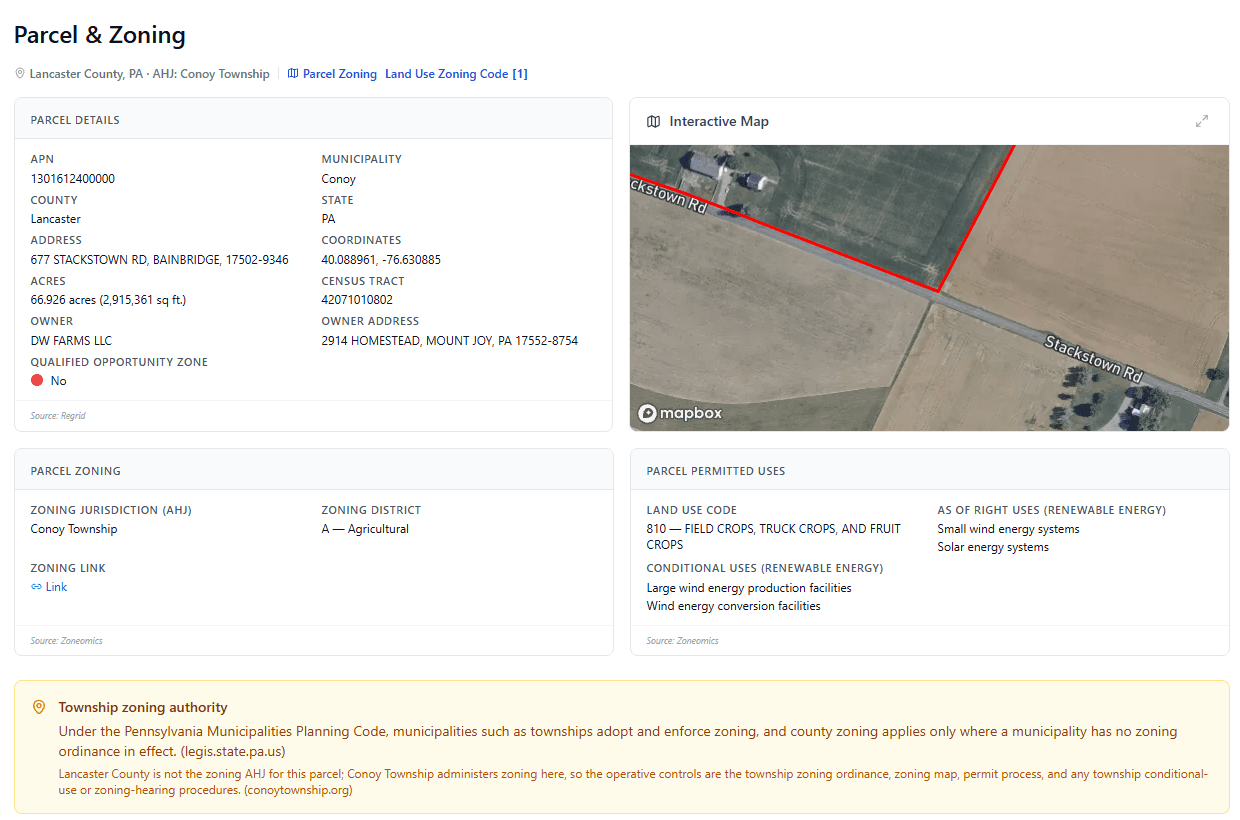
Are data centers permitted on this parcel?
Data centers require a conditional use permit in the I-2 district1. Commissioners discussed a temporary moratorium in March but tabled it2, and two residents spoke against noise at the last hearing3.
Deployment intelligence engine
Evaluate sites, navigate permitting requirements, track community sentiment, and monitor changes in real time
Selection
Assess prospective sites based on land use and past projects
Requirements
Extract permitting feasibility from zoning ordinances and moratoria
Interpretation
Derive community sentiment from local authorities, town hall meetings, and social media
Workflows
Accelerate portfolio and M&A diligence with automated analysis
End-to-end site screening, diligence & risk analysis
From first screen to groundbreaking, and everything that changes after.
Developer testimonials: faster decisions, better site outcomes
How best-in-class developers accelerate their projects with Spark
“Spark's data is part of how we screen sites. It helps us spot local opposition and moratorium risk early.”
 AZ
“Spark AI has transformed how we approach renewable energy projects, combining cutting-edge AI with insightful diligence tools. It's been a game-changer, speeding up our evaluations and improving site selection accuracy.”
 CI
“Spark has significantly enhanced our development efforts at Stellera. The platform's ability to efficiently analyze critical project variables allows us to identify opportunities with greater accuracy and speed.”
 ES
“Spark AI is excellent at quickly accessing current information on moratoriums, zoning, opposition, etc., in counties where we plan to develop new projects. It saves significant time and provides better results than manual research.”
 DP
“Using Spark, I was able to finish a project in days that otherwise would have taken 3 weeks. Spark is a great tool for navigating complex documents. It saves time, energy, and is very simple to use.”
 MS
Built by experts in energy infrastructure & AI software
Our team hails from top technology + energy companies and academic institutions






FAQ
Spark is not just site screening. It's permitting + zoning + local sentiment intelligence you use alongside GIS and mapping tools: Spark answers "can we actually get this built here?" with evidence-backed outputs (ordinance language, moratoria, process steps, red flags), not just a score.
Core differences:
- Zoning + permitting depth: Spark scans and structures ordinances, land use codes, moratoria, meeting minutes/agendas, filings, and other local records.
- Sentiment as a first-class risk signal: Spark tracks community opposition signals that often show up online (on social media, for example) before hearings.
- Auditable, repeatable diligence: crawl → extract → normalize → index → cite, so outputs remain traceable to sources instead of "best-effort" summaries.
ChatGPT and Claude are general-purpose models that generate text word by word, optimized to sound coherent rather than to be complete, reproducible, or verifiable. Even when they “cite” a source, the answer is still generated probabilistically, so a claim may not actually come from that document, and they can blend in training data (for example, confusing two of the 32 Washington Counties in the U.S.). Spark works the other way around: instead of a one-off web search each time you ask, it continuously collects a terabyte-scale database of zoning ordinances, meeting minutes, filings, and local news from known sources. Purpose-built extractors pull out what matters for permitting (by-right vs. conditional use, setbacks, moratoria, decommissioning, noise rules), and every finding links to the exact page it came from. The same question on the same data returns the same answer, so results hold up in investment committee and diligence. When the evidence isn't there, Spark shows the relevant excerpts or tells you what it couldn't find instead of inventing an answer. It also watches for changes and alerts you to new ordinances, moratoria, and agendas, which a chat session can't do on its own. Documents you upload are covered by zero data retention and SOC 2 controls.
Spark crawls multiple times per week, continuously scanning authoritative public sources (AHJ sites, agendas/minutes, filings, local news) and storing each finding with a citation and timestamp.
Nationwide coverage across all 50 U.S. states, down to county and township levels (where online public-source presence exists).
Spark supports utility-scale solar, storage (BESS), and data centers. It also supports broader infrastructure diligence via the permitting matrix workflow (including wind, natural gas, and beyond).
Spark is built for diligence-grade security and traceability:
- Zero Data Retention: uploaded permitting/zoning/M&A documents are not stored or shared with any AI model provider for training.
- Enterprise-grade security practices: encryption, access controls, and audit logging consistent with enterprise expectations.
- Citations without exposure: answers include page-level citations, but references remain inside the secure workspace; underlying documents don't leave that environment.
No. Uploaded documents are not used to train AI models and are not shared with model providers for training.
Annual software subscription. Pricing typically depends on seats + usage volume. Book a call and we can provide a quote based on your specific needs.
See Spark in action
Tell us about your pipeline. We'll show you which sites can get built, and which ones to drop.